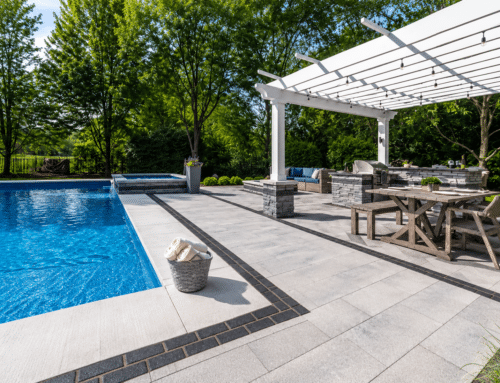
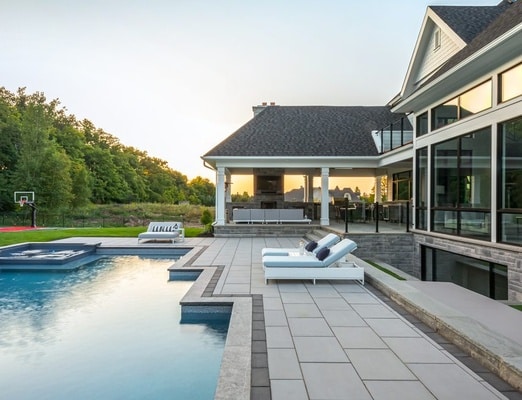
Unilock Beacon Hill Smooth used on a pool deck with lounge seating and a modern backyard pool.
Pool deck pavers should be chosen for wet-condition traction, surface temperature, durability, maintenance, drainage, and design—not appearance alone.
Concrete pavers and slabs, natural stone, porcelain, and permeable paving systems can all work around a pool when the specific product and finish are suitable for the application. For projects in Massachusetts and Rhode Island, freeze-thaw exposure and seasonal conditions should also be part of the decision.
Start by considering how the pool area will be used, how much direct sun it receives, and how water will move across the space. From there, compare materials, finishes, colors, formats, maintenance requirements, and manufacturer recommendations before selecting a product.
What Makes a Good Pool Deck Paver?
The right pool deck paver needs to perform well in an area regularly exposed to water, sunlight, foot traffic, and changing weather conditions.
Start with traction in wet conditions and comfort underfoot, then consider maintenance, drainage, durability, and how the color, texture, size, and pattern fit the surrounding architecture and landscape.
Because these characteristics can vary by product and finish, compare the specifications of the exact pavers or slabs being considered rather than relying on material type alone.
Best Pool Deck Paving Materials
Different materials offer different combinations of appearance, maintenance, texture, and performance. There is no single material that is best for every pool deck, so the goal is to compare the specific products that fit the conditions of the project.
Concrete Pavers and Slabs
Concrete pavers and slabs offer a wide range of colors, textures, sizes, and finishes, making them flexible for both traditional and contemporary pool designs. Old Station Supply’s pavers and slabs include options across different formats and design styles.
For poolside use, compare the specific product’s surface finish, traction in wet conditions, surface temperature, and approved applications. These characteristics can vary significantly between collections.
Look for products specifically recommended by the manufacturer for pool deck applications.
Natural Stone Pavers
Natural stone brings variation in color and texture that can make a pool deck feel closely connected to the surrounding landscape. Options within Old Station Supply’s natural stone selection include materials that can support a range of traditional and contemporary pool designs.
Bluestone, granite, and limestone are among the natural stone options worth comparing. The exact finish is important because texture, comfort, maintenance, and wet-condition traction can differ even within the same stone family.
For natural stone, evaluate the specific stone type and finish for wet-condition traction, surface temperature, and maintenance requirements.
Porcelain Pavers
Outdoor porcelain pavers designed for poolside applications offer a consistent appearance, low water absorption, and relatively low maintenance. Stone-inspired finishes can work especially well in contemporary pool areas where a more uniform look is preferred.
For any poolside project, confirm that the exact porcelain product and finish are intended for wet outdoor areas, and review the manufacturer’s traction and installation requirements.
Pool Deck Pavers to Compare at Old Station Supply
If you are narrowing down specific products, these options represent different materials, formats, and design directions:
- Unilock Beacon Hill Flagstone — a concrete paver inspired by natural cut flagstone, with a subtle textured surface and a three-size random bundle. Unilock lists Beacon Hill Flagstone for pool surrounds, patios, and walkways, making it worth comparing when a more natural, varied appearance is part of the pool deck design.
- Techo-Bloc Eva Slate — a 60 mm concrete paver with a chiseled, flagstone-inspired surface and a three-size modular format. Techo-Bloc lists Eva Slate for pool decks, patios, walkways, and driveways, making it worth comparing when a natural stone-inspired look and smaller modular sizes fit the pool deck design.
- Belgard Dimensions — a concrete paver and slab family with clean lines and modular sizing that can be combined in different layouts. Belgard lists Dimensions for pool decks, patios, and walkways, making it worth comparing when a structured, contemporary appearance and flexible pattern options are priorities.
- Infinite Outdoor Porcelain Paver Granite Grey — a light-gray porcelain paver available in 12 in × 24 in, 24 in × 24 in, and 24 in × 36 in formats. Its consistent stone-inspired appearance and mix of rectangular and square sizes make it useful for pool areas where a more uniform look and layout flexibility are priorities.
Product sizes, colors, and availability can change. Confirm current specifications and poolside application requirements before making a final selection.
Traction, Surface Temperature, and Safety Considerations for Pool Deck Pavers
Rather than looking for a material described simply as “non-slip,” evaluate the exact surface and its performance in wet conditions. Texture and traction can vary between products made from the same material.
Surface temperature is another important consideration. Material, color, finish, sun exposure, and site conditions can all influence how a pool deck feels underfoot.
If barefoot comfort is a priority, compare samples and product information for the specific options being considered rather than assuming that every concrete, stone, or porcelain surface will perform the same way.
Drainage should also be considered as part of the overall pool deck design. Proper grading and installation help control how water moves across and away from paved surfaces.
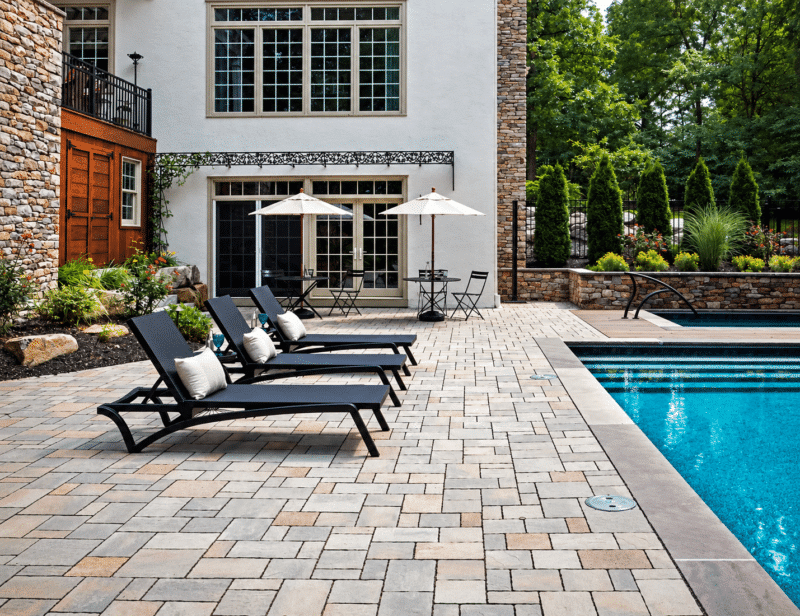
Techo-Bloc Eva Slate Pavers in Champlain Grey used to create a textured pool deck with a modular layout.
Choosing Pool Deck Pavers for New England Conditions
Pool deck projects in Massachusetts and Rhode Island also need to account for seasonal weather.
For New England installations, verify that the selected product is rated for freeze-thaw conditions and review the manufacturer’s guidance for cleaning products, deicing materials, sealing, and other maintenance conditions that may apply to the project.
Product choice is only part of the equation. Base preparation, drainage, jointing, and installation requirements also affect how the finished paving system performs over time.
Drainage and Permeable Paver Options
Drainage should be planned as part of the entire pool area rather than considered only after the pavers are selected. Site grading, the base system, joints, and surrounding hardscape all influence how rainwater moves through or across the space.
For projects where runoff management is a priority, a permeable paver system can provide another option to compare with conventional paving systems. Belgard Aqualine is one product that can be considered when permeable paving is part of the project requirements.
Whether a permeable system is appropriate will depend on the site, drainage goals, installation design, and product requirements.
Pool coping should also be planned alongside the deck material. Coordinating the coping and surrounding paving early can make it easier to align colors, finishes, elevations, and installation details across the pool area.
Pool coping forms the finished edge immediately around the pool and may use a coordinating or contrasting product designed for that application.
How to Maintain Pool Deck Pavers
Regular cleaning can help preserve the appearance of pool deck pavers and prevent dirt, leaves, and other debris from accumulating around frequently wet areas.
Maintenance requirements vary by material and manufacturer. Some products may benefit from sealing, while others may have different cleaning or care requirements.
Follow the manufacturer’s recommendations for the exact surface, particularly before applying sealers, cleaners, or other treatments around a pool. Monitor joints, settling, stains, and damaged units so maintenance needs can be addressed early.
Budgeting for Pool Deck Pavers
The cost of installing pavers around a pool depends on more than the material itself. Product selection, project size, base preparation, drainage requirements, pattern complexity, cuts, access, coping, and installation can all affect the final investment.
Because of these variables, comparing only the price per square foot of the paving material can give an incomplete picture of the project. Our guide to paver patio cost explains the broader project factors that can affect pricing and is useful when establishing an initial budget.
Conclusion
Choosing the right pool deck pavers means balancing traction, surface temperature, drainage, maintenance, climate, design, and budget.
Concrete, natural stone, porcelain, and permeable paving systems can all be worth considering, but the final decision should be based on the specific product and project conditions. If you are still comparing materials and formats, our guide to choosing the right pavers and slabs can help you evaluate the broader options.
Ready to narrow down your options? Visit the Old Station Supply showroom in Norton to compare materials, colors, formats, and textures in person. Once you find a product that fits your project, visit its product page to request current pricing and availability from Old Station Supply.