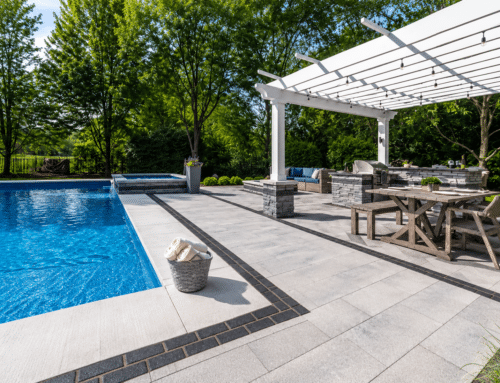
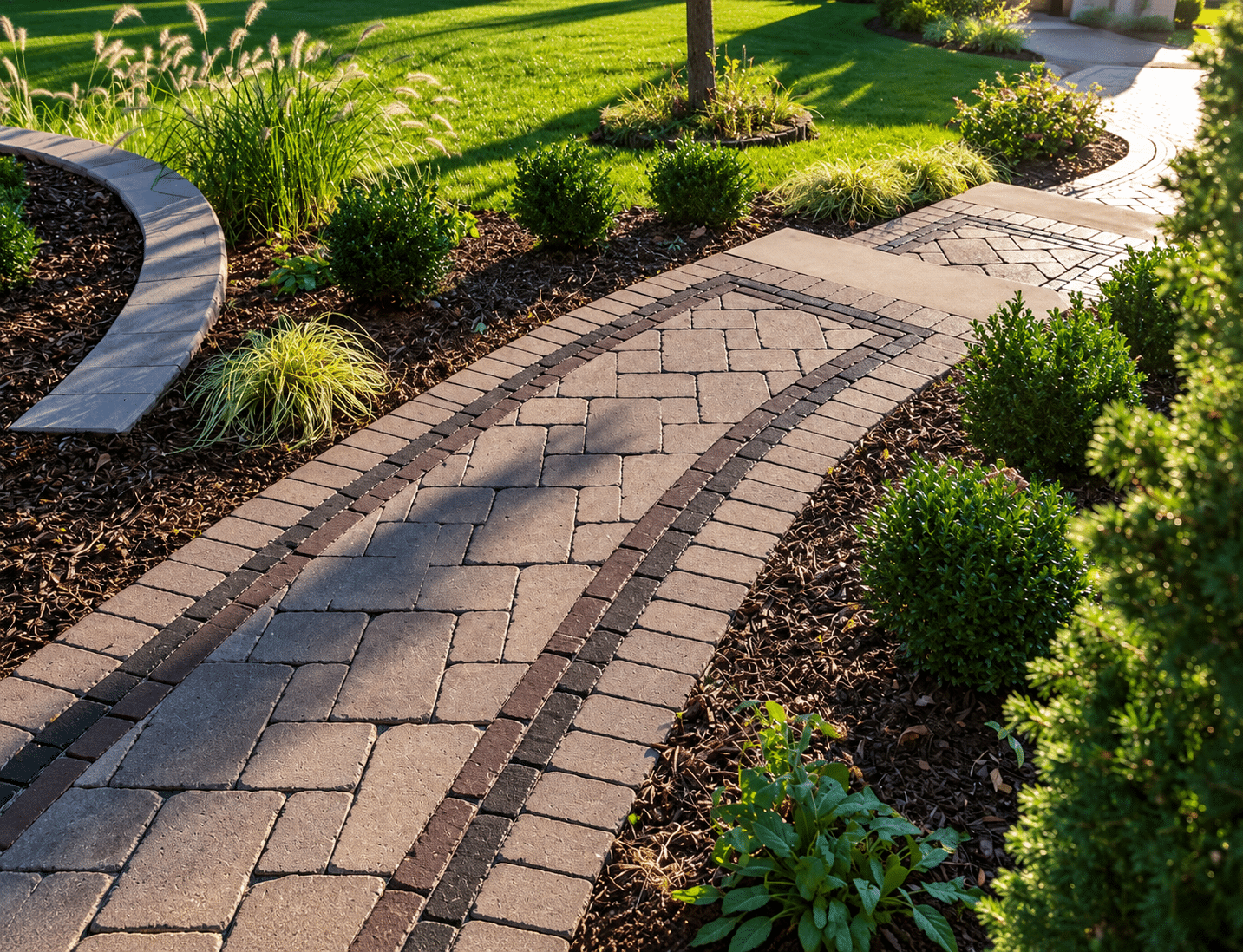
Unilock Brussels Block in Sierra used to create a curved garden walkway with contrasting borders.
Successful paver walkway designs combine the right path layout, paver size, material, pattern, and surrounding landscape. Straight walkways create a direct route to an entrance, while curved or meandering paths work well through gardens and less formal landscapes.
The right pavers should also fit the walkway’s foot traffic, drainage needs, maintenance expectations, and the design of nearby patios, driveways, and planting areas.
Whether you’re planning a front walkway, garden path, side-yard connection, or a route to a patio or pool area, start with how the path needs to function. From there, you can compare paver formats, materials, colors, textures, and patterns that support the overall design.
What Are Paver Walkways?
Paver walkways are outdoor paths built from individual paving units such as concrete pavers, natural stone, or permeable paving systems.
Because these materials are available in different shapes and sizes, a walkway can follow a direct architectural line, curve through a garden, or incorporate borders and pattern changes to connect different areas of the property. Compared with a continuous poured surface, individual paving units provide greater flexibility in layouts, patterns, and material combinations.
Paver Walkway Design Ideas
There is no single walkway layout that works for every property. The right design depends on where the path leads, how it will be used, the available space, and the architectural and landscape style around it.
Straight and Linear Walkways
Straight walkways create a structured, direct route and work especially well between a driveway, sidewalk, front entrance, patio, or another clearly defined destination.
Clean lines can be reinforced with rectangular or modular pavers, contrasting borders, or a simple repeating pattern. This approach often works well with contemporary and more formal landscapes.
Curved and Meandering Walkways
Curved walkways create a softer transition through gardens and landscaped areas. They can guide the path around planting beds, trees, walls, or other existing features rather than forcing the landscape into a straight line.
Paver size matters here. Smaller or narrower units can provide more flexibility when creating curves and detailed layouts. For example, Unilock Mattoni uses a narrow format that can work especially well for winding paths and more detailed patterns.
Patterned and Geometric Walkways
The paving pattern can become an important part of the walkway design.
Running bond, herringbone, basket-weave, modular, grid, and offset layouts can each create a different visual effect, depending on the shape and size of the selected paver.
More geometric layouts can reinforce contemporary architecture, while traditional patterns can help create a more established or classic appearance.
Stepping-Stone and Mixed-Material Walkways
A walkway does not always need to be completely paved from edge to edge.
Larger paving units or natural stone can be combined with gravel, planting areas, or other landscape materials to create a more informal garden path. When using this approach, spacing, stability, drainage, and the intended walking surface should all be considered as part of the design.
How to Choose Pavers for a Walkway
Start with the route and function of the walkway.
A main entrance path may benefit from a more defined layout, while a garden path can accommodate more variation in shape and material. Think about how people will move through the space and how the walkway connects with steps, patios, driveways, gates, and planting areas.
Next, consider the paver format. Smaller and narrower units provide more flexibility for curves and detailed patterns. Larger pavers or slabs can create fewer visual breaks and cleaner lines, but the dimensions of the walkway and the number of required cuts should be considered before selecting the format.
Color and texture should also relate to the surrounding property. Rather than choosing the walkway in isolation, compare it with the home exterior, existing hardscape, walls, steps, and landscape materials.
For projects in Massachusetts and Rhode Island, drainage, freeze-thaw exposure, installation requirements, and the manufacturer’s recommendations for deicing products and winter maintenance should also be reviewed.
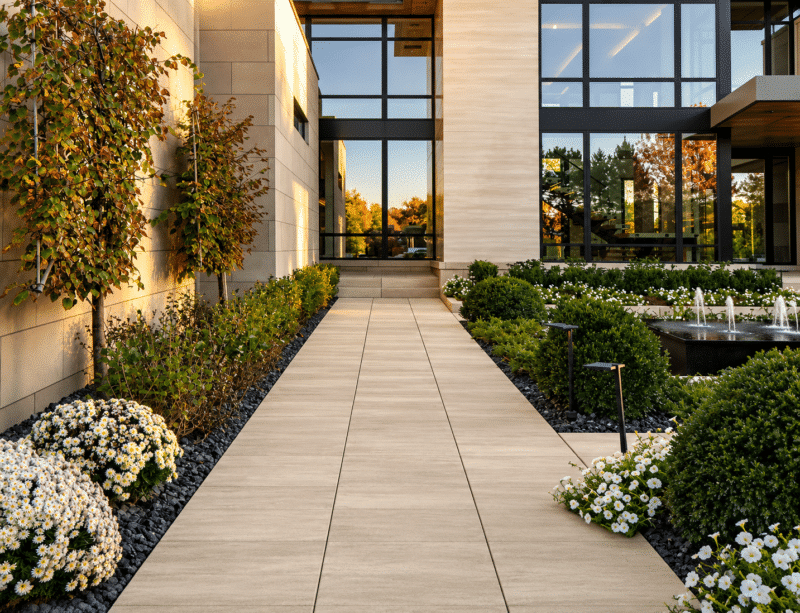
Techo-Bloc Industria Smooth Slabs in Caffè Crema used to create a clean, modern walkway leading to a contemporary home.
Choosing the Right Material for a Paver Walkway
Material affects both the appearance of a walkway and the decisions that need to be made during installation and long-term care.
Concrete and Manufactured Pavers
Concrete pavers provide a broad range of shapes, formats, colors, and surface styles.
They can support traditional, transitional, or contemporary walkway designs depending on the selected product. Smaller units may work well for curves and detailed patterns, while modular and larger-format options can create straighter, cleaner layouts.
When comparing concrete pavers, look beyond color alone. Size, surface texture, pattern options, installation requirements, and the intended application should all be considered.
Explore our Pavers & Slabs selection and review each product’s intended applications.
Natural Stone
Natural stone offers inherent variations in color, texture, and pattern that can give each walkway a distinct appearance.
Limestone, bluestone, granite, sandstone, and other natural materials can create anything from a structured entrance path to a more informal garden walkway. The appropriate stone, thickness, finish, installation method, and maintenance approach depend on the specific product and application.
Permeable Pavers
When drainage or stormwater management is an important project consideration, a permeable paving system may be worth comparing with conventional pavers.
Permeable performance depends on the complete installed system, including the pavers, joints, base, and site conditions, rather than the surface unit alone. Old Station Supply’s guide to permeable pavers and drainage solutions provides additional context for projects where runoff management is part of the decision.
Walkway Pavers to Compare at Old Station Supply
A few different products can help illustrate how material and format change the direction of a walkway design:
- Unilock Brussels Block — a tumbled concrete paver with an antiqued, stone-inspired appearance that works well for walkways where a more traditional or relaxed look is desired. Unilock lists it for patio and walkway applications.
- Techo-Bloc Industria Smooth Slabs — a large-format concrete slab with a smooth surface and clean, modern lines, well suited to contemporary walkway designs. Techo-Bloc offers Industria Smooth in square and rectangular formats.
- Belgard Dimensions — a concrete paver and slab family with clean lines and modular sizing that can be combined in different layouts. It is worth considering for walkways where a structured appearance and flexible pattern options are priorities.
- Unilock Limestone in Black River — a natural limestone option with darker tones and the color and texture variation expected from natural stone. It is worth comparing for walkways where larger formats and natural stone character are central to the design.
Maintenance and Care for Paver Walkways
Maintenance requirements vary by material, surface finish, jointing system, site conditions, and manufacturer recommendations.
Routine care generally begins with removing leaves, dirt, and other debris before they build up on the surface or in the joints. Stains, moss, algae, or joint deterioration should be addressed with methods and products appropriate for the specific paving material.
Do not assume that pressure washing, chemical cleaners, herbicides, or sealers are appropriate for every walkway. Follow the manufacturer’s recommendations for the selected paver or stone.
Depending on the installation and availability of matching material, individual damaged units may be replaceable without rebuilding the entire walkway.
Conclusion
A successful walkway starts with the route it needs to follow and then works backward through paver size, material, pattern, color, texture, drainage, and installation requirements. Straight paths often work well with clean modular layouts, while curved garden paths may benefit from smaller or more flexible formats.
Once you have narrowed down the design direction, compare the actual materials before making the final selection. At Old Station Supply in Norton, you can review paver formats, colors, textures, and natural stone options in person.
When you find a product that fits your project, visit its product page to request current pricing, availability, and project-specific information from Old Station Supply.