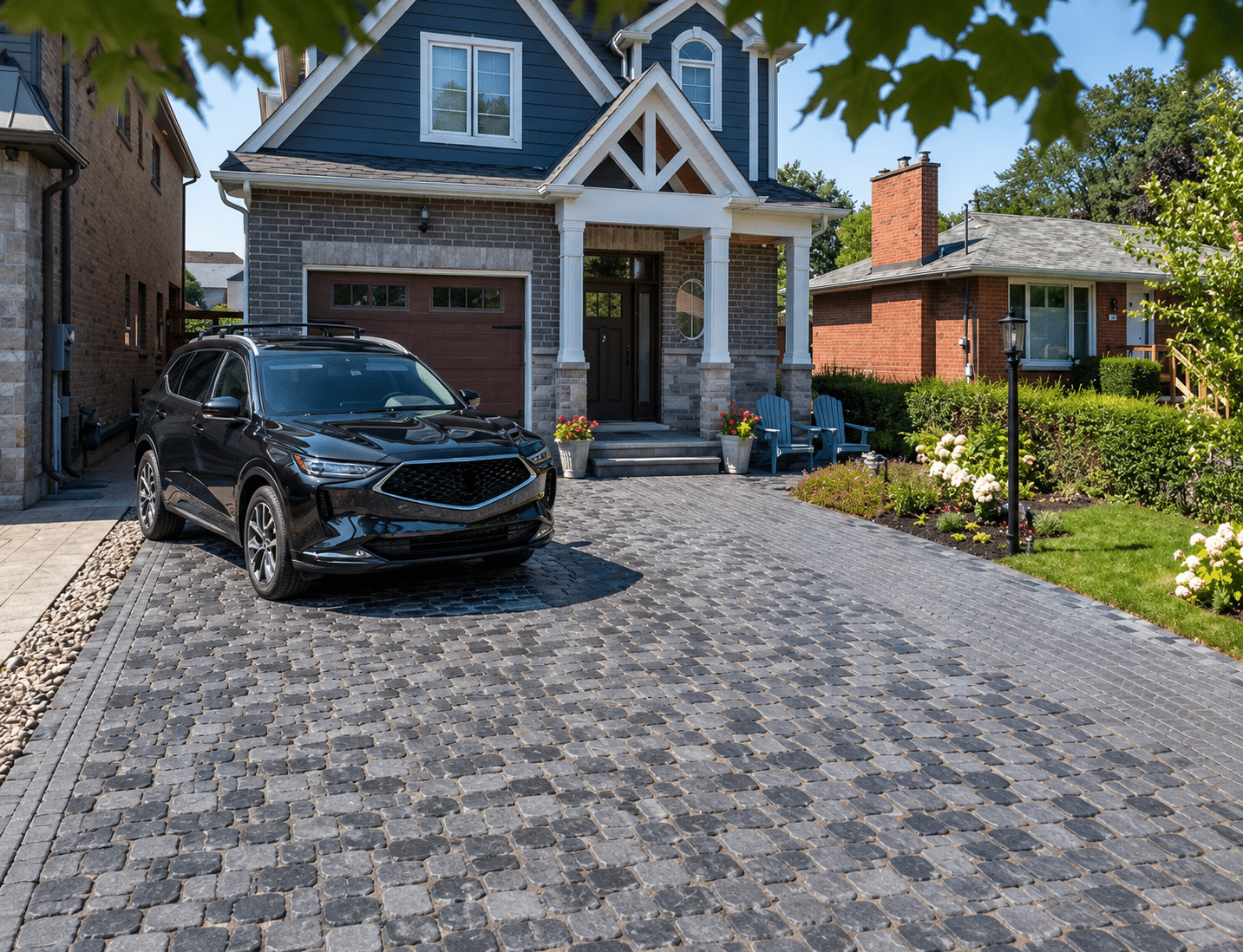
Unilock Courtstone used to create a residential paver driveway with a cobblestone-inspired look.
For a successful driveway, start with a paver specifically rated for vehicular use, then narrow your options by material, pattern, drainage, maintenance, and the style of the property.
In New England, base preparation, freeze-thaw exposure, snow, and deicing practices also need to be considered as part of the complete paving system.
Concrete pavers, natural stone, cobblestone-inspired options, and permeable systems can create very different driveway designs, but not every paver or slab is suitable for vehicle loads. This guide covers the materials, patterns, design ideas, and practical factors to compare before choosing a driveway paver.
How Do Paver Driveways Compare With Concrete or Asphalt?
While asphalt and poured concrete are common choices, paver driveways offer greater flexibility in color, texture, pattern, and material selection.
Individual pavers can often be replaced when necessary without rebuilding the entire paved surface. For projects where stormwater management is important, permeable pavers can help water move through the pavement system instead of running directly across the surface.
Pavers are not automatically the right choice for every driveway. Budget, site conditions, maintenance expectations, drainage, and installation requirements still matter.
Most importantly, the selected product should be specifically appropriate for vehicular use. Paver thickness, vehicular rating, base preparation, drainage, edge restraint, and installation requirements should all be considered before the driveway material is finalized.
Popular Paver Driveway Design Ideas
Well-planned paver driveway designs combine appearance with practical product selection. Pattern, color, format, and borders can change the look of the driveway, but they should work with the selected paver rather than drive the decision by themselves.
Modern and Traditional Driveway Paver Styles
Modern driveway pavers often use smooth gray surfaces, linear formats, and cleaner layouts to complement contemporary architecture.
Traditional designs can use warmer tones, brick-inspired formats, cobblestone-style pavers, or natural stone details to create a more traditional New England look.
The surrounding architecture, walkways, steps, walls, and landscape should help guide the style rather than treating the driveway as an isolated surface.
Paver Patterns That Stand Out
Herringbone is commonly used for vehicular paving because its layout can provide strong horizontal interlock. Running bond and linear layouts can produce a cleaner, more directional appearance.
The pattern should also be compatible with the selected paver and manufacturer installation recommendations. A layout that works well with one paver format may not be appropriate for another.
Borders, Edges, and Accents
A contrasting border can define the driveway without making the main field overly busy. Different tones of pavers or compatible natural stone can also help connect the driveway to walkways, steps, or other hardscape areas.
For shorter driveways, a simpler field pattern with one defined border can keep the layout visually clean. On wider or longer driveways, accent bands or changes in pattern can help break up a larger paved surface.
Best Materials for Paver Driveways
Not every paver or slab is designed to support vehicle loads, so vehicular rating should be one of the first specifications checked when comparing driveway materials.
Concrete Pavers
Concrete pavers offer a broad range of colors, textures, shapes, and design styles. Depending on the product, they can support contemporary, traditional, or transitional driveway designs.
For a driveway, confirm the specific product is rated for vehicular use and that the required installation system matches the project conditions.

Techo-Bloc Westmount pavers used across a residential driveway with a modern home and landscaped border.
Cobblestone and Brick-Inspired Pavers
Cobblestone driveway pavers and brick-inspired formats can create a more traditional appearance without limiting the driveway to one specific color or pattern.
Depending on the product, they can be used across the main driveway or as borders and accent areas. Vehicular suitability should still be confirmed for the individual paver.
Natural Stone
Granite and other natural stone paving products can create a distinctive appearance and work particularly well with traditional New England architecture.
Suitability depends on the specific stone, thickness, dimensions, finish, and installation system. Natural stone should not automatically be treated as driveway-ready simply because of the material category.
Permeable Paver Systems
Permeable pavers can provide a paved driving surface while allowing water to move through aggregate-filled joints and the pavement system below.
They can be especially useful when stormwater management is part of the project, but permeability depends on the entire installation system rather than the surface paver alone.
Driveway Pavers to Compare at Old Station Supply
When narrowing the selection, these products represent different driveway design and drainage directions:
- Unilock Courtstone — a concrete paver with a cobblestone-inspired appearance that can work well for driveway projects where a more traditional look is part of the design.
- Techo-Bloc Westmount Paver — a linear concrete paver designed for vehicular applications, with elongated proportions that create a more directional appearance. It is worth comparing for contemporary driveways where clean lines and a linear layout are priorities.
- Belgard Aqualine — a permeable concrete paver designed for permeable pavement systems that allow water to move through the joints. It is worth considering for driveway projects where stormwater management and a more structured paving pattern are both part of the plan.
- Techo-Bloc Aquastorm — a permeable concrete paver characterized by wider openings that can be filled with aggregate or vegetation depending on the system design. It is worth comparing for driveways where water infiltration and a more open permeable-paving appearance are priorities.
Functional Considerations for Your Driveway
Drainage and Permeability
Drainage should be planned with the driveway rather than treated as an afterthought.
A permeable paving system can help manage water on suitable sites, but the paver, joint material, base, subgrade, and overall drainage design need to work together.
Lighting, Edging, and Edge Restraint
Landscape lighting along driveway edges can improve nighttime visibility while helping define the paved area.
Proper edge restraint is also part of the driveway installation system. The appropriate method depends on the selected paver, base, layout, and manufacturer or installer requirements.
Retaining Walls, Steps, and Grade Changes
On sloped properties, retaining walls and steps may be needed to connect the driveway with walkways, entrances, or other elevations.
When those elements are part of the same project, coordinating materials can create a more intentional overall landscape. Explore additional hardscape supplies when planning these transitions.
Maintenance Tips for Long-Lasting Driveways
One advantage of a modular paver surface is that individual units can often be repaired or replaced without disturbing the entire driveway.
For routine maintenance, remove leaves and debris and use cleaning methods appropriate for the specific paving material.
Sealing requirements vary by manufacturer and product. Rather than following a fixed schedule for every driveway, check the care recommendations for the selected paver before applying a sealer.
During winter, follow the paver manufacturer’s recommendations for snow removal and deicing products. Joint condition, drainage, and edge areas should also be inspected as part of regular maintenance.
Paver Driveway Cost and Project Considerations
Paver driveway cost depends on much more than the surface material.
The selected paver, excavation, base preparation, drainage requirements, driveway size, pattern complexity, cuts, site access, and labor can all affect the final project cost.
Because of those variables, broad cost-per-square-foot estimates may not accurately represent an individual driveway. Once you’ve narrowed down your product options, visit the individual product pages to request current pricing and discuss project-specific material requirements with Old Station Supply.
Beyond upfront cost, pavers offer flexibility in material, pattern, and design, which can be useful when considering how the driveway fits into the broader landscape.
Paver Driveways in New England
Driveways in Massachusetts and Rhode Island need to perform through seasonal temperature changes, snow, moisture, and freeze-thaw conditions.
Product rating and installation are especially important. The paver, base system, joints, drainage, edge restraint, and winter-maintenance approach should work together rather than relying on the surface material alone.
Deicing compatibility should also be checked for the selected product rather than assumed across an entire material category.
Permeable driveway systems can help manage rainwater and snowmelt when site conditions and project design support their use.
From a design perspective, concrete pavers can complement contemporary properties, while cobblestone-inspired formats and natural stone details can work particularly well with traditional New England architecture.
Conclusion
A successful paver driveway starts with product suitability, not pattern alone. Choose a paver rated for vehicle traffic, then compare material, drainage, layout, maintenance, and how the driveway connects with the rest of the property.
Successful paver driveway designs combine these practical requirements with a design that fits the home and surrounding landscape.
Need help comparing your options? Visit our Norton showroom to review materials, colors, textures, and formats in person, or visit an individual product page to request current pricing and availability from Old Station Supply.